 Press release: 18 July]]>
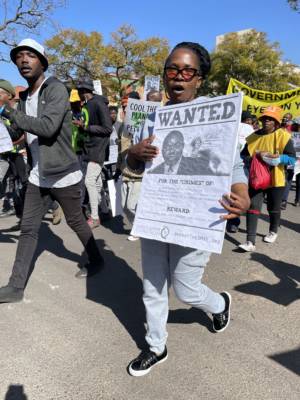
South Africa – This Nelson Mandela Day, the Climate Justice Coalition (CJC), a coalition of South African trade unions, grassroots, community-based and non-profit organisations, will march to the Office of the Presidency. The Coalition is petitioning President Cyril Ramaphosa to fix South Africa’s dual energy and climate crisis. The Coalition’s central demands call for the President to implement an emergency renewable energy plan to end load-shedding, replace Minister Mantashe, and fix the Department of Mineral Resources and Energy (DMRE).
With 2022 set to be the worst year of load-shedding and electricity prices at an all-time high, members of the Coalition are part of a growing public call for renewable energy solutions to address South Africa’s energy crisis. Several recent studies demonstrate that South Africa could solve load shedding by unlocking renewable energy. Renewable energy is shown to be the fastest, cleanest and most affordable way to end load-shedding. A just transition to renewable energy is also critical to reduce deadly air pollution and tackle the climate crisis.
According to the coalition, Minister Mantashe’s DMRE is holding back the country’s transition to a renewable energy future and has failed to bring new energy online. Instead, the DMRE is trying to lock South Africa into polluting and expensive coal, diesel and gas. The CJC is demanding that President Ramaphosa remove Mantashe from office and put in place new and capable leadership at the Department of Mineral Resources and Energy.
Cleopatra Shezi, community organiser with United Front, said,
“Loadshedding is devastating our country, and the DMRE is failing to bring new energy online. The health of our communities is at risk because our energy supply is unstable. We can’t keep our food or medicine refrigerated. Senior citizens who rely on oxygen machines are dying because of a lack of power. The DMRE is also driving unemployment and poverty, because they are choosing expensive and polluting energy, over affordable and clean energy. ”
Meshack Mbangula, the National Coordinator of Mining Affected Communities United in Action said,
“We as mining-affected communities are facing exclusion from the decision-making process, especially when those decisions will impact our livelihoods. We have been trying to engage the DMRE to listen to the demands of mining-affected communities but all our efforts fall on deaf ears. The department continues to fail communities. Corruption is the order of the day, while communities continue to bear the brunt from the negative impact of the mining industry. When we stand up for our rights, our activists, our people are being killed.”
Dr Alex Lenferna, secretary of the Climate Justice Coalition and campaigner with 350Africa.org, said,
“We need an emergency energy plan to get us out of this energy disaster. But we can’t rely on the same minister who failed to deliver on the last emergency energy plan, to deliver on the next one. That’s why President Ramaphosa must replace Minister Mantashe with someone capable of delivering. Renewable energy and storage are the fastest, cheapest and cleanest way to bring new energy online, not Mantashe’s polluting powerships, outdated coal, or expensive nuclear.”
Raeesah Noor-Mahomed, youth activist with the African Climate Alliance, said,
“The youth are tired of seeing our future being destroyed. Coal, oil and gas are devastating the environment and driving the climate crisis. Those impacts fall most heavily on those already marginalised and vulnerable, causing ecological apartheid. Yet, Minister Mantashe has the audacity to accuse environmental activism of ‘colonialism of a special type’. We have the opportunity to fix our energy crisis and build a better and brighter energy future through renewable energy. South Africa has great potential for solar and wind, but we need to act now, or our futures will be lost”
Peter Becker, of the Koeberg Alert Alliance, one of 16 groups in the Energy Governance South Africa Network supporting the demand for an immediate section 34 determination to allow for new renewable generation capacity from Minister Mantashe, said
“Until the roadblocks to new renewable capacity are removed, the electricity crisis will not be resolved. Instead of spending tens of billions of rand on expensive distractions like nuclear and gas, Eskom could build gigawatts of renewable capacity. But without the Minister issuing a section 34 determination, their hands are tied. We need action from the DMRE now!”
###
Notes for Editors
About “Uproot the DMRE”
#UprootTheDMRE is a campaign by The Climate Justice Coalition (CJC) seeking the transformation of the Department of Mineral Resources and Energy, to ensure a more socially, economically and environmentally just energy and mining future. More information about the campaign and its demands is available on the Uproot the DMRE website
The Climate Justice Coalition is a coalition of nearly 40 South African trade unions, civil society, grassroots, and community-based organisations, working together to advance a transformative climate justice agenda that tackles the inequality, poverty and unemployment that pervades South Africa. More about the coalition is available at their website: ClimateJusticeCoalition.org
The full list of the Coalition’s demands is available in the petition.
350Africa.org
Boitumelo Masipa
Email:[email protected] | [email protected]
Telephone:+27 (0) 824529096
]]> Load shedding will get even worse unless we implement an emergency plan to roll out renewable energy and storage and appoint a new energy minister capable of delivering. By Alex Lenferna and Cleopatra Shezia
]]>
Load shedding will get even worse unless we implement an emergency plan to roll out renewable energy and storage and appoint a new energy minister capable of delivering. By Alex Lenferna and Cleopatra Shezia
]]>On 2 June, Minister Gwede Mantashe signed power purchase agreements for new solar and storage power plants, as part of his Department of Mineral Resources and Energy’s (DMRE) emergency power programme. Sadly, what might seem on its face to be good news, is a worrying sign that load shedding is set to deepen.
As residents of South Africa are painfully aware, 2022 is on track to be our worst year of load shedding ever. Our badly ageing, poorly maintained coal plants are not keeping up with South Africa’s demand for energy. Eskom, for its part, has put out a code red saying that it urgently needs additional new energy supply to prevent load shedding from worsening in the near future.
Compared to what Eskom needs to solve its code red, Mantashe’s flagship emergency power procurement program is failing. The program has seen three delays to its “non-negotiable” deadline of July 2021. After all those delays, last week’s newly signed solar projects represented a tiny 150MW of the 2,000MW the program was supposed to deliver.
By comparison, Eskom’s current supply gap is between 4,000 MW and 6,000 MW. Eskom also needs to retire 22,000 MW of badly ageing coal generation capacity over the next 13 years, if not more. So, by the time the new solar projects come online, they will only meet around 3% of the current energy supply gap and 0.5% of the future energy supply gap we face.
One big obstacle to Mantashe’s emergency program has been the corruption allegations around the powership projects, which make up the majority of the program. Apart from being snared in legal and environmental challenges, the polluting powerships are also proving to be uneconomic, especially with gas prices so high and so volatile.
Rather than throwing in the towel on the failed powerships, Mantashe seems dead set on pushing it through. One wonders if it has to do with who will benefit from the R200-billion-plus project. Whatever the motivation, the result is that we have a stalled emergency energy program that may never see the majority of its proposed projects come to light.
Sadly, that’s not the only energy plan that Mantashe’s DMRE is failing to deliver on. The DMRE is also failing to deliver on its outdated Integrated Resource Plan (IRP) of 2019, which is meant to determine new energy that should be bought online in South Africa. Even before it was written, the IRP was out of date.
The IRP aims to build lots of polluting, outdated, and/or expensive projects, such as new coal, gas and nuclear. Most of those would take many years to come online, leaving us stuck with load shedding well into the future. That is, if they ever get built in the face of cheaper renewables. If they do get built though, many are likely to be white elephants, with a similar fate to Medupi, which has driven up energy prices and is projected to never turn a profit.
Meanwhile, renewable energy, the fastest, cleanest and most affordable solution to our energy crisis, was constrained under the IRP. Worse still, the very limited renewable build that the IRP allowed is languishing in the face of the DMRE’s failures and slowness. The DMRE has not successfully added a single new publicly procured megawatt to the grid since Mantashe’s appointment in 2019, apart from those in the pipeline from his predecessor.
The DMRE’s energy plans and emergency plans are both failing to deliver. The result is that our energy supply gap is likely to grow, making load shedding worse in the years to come. According to a recent report by Meridian Economics, it could get as bad as stage 6 or 8. We are in a deep emergency.
So, we need a real emergency plan and to implement it yesterday
We could learn from the US, which just invoked its Defense Production Act to rapidly roll out renewable energy. In the next few years, they will build enough domestic solar manufacturing capacity to power 3.3 million new homes with solar a year. That will be coupled with programs to insulate buildings, install efficient heat pumps, upgrade grid infrastructure, drive green industrialisation and more.
Similarly, in the face of the Ukraine-Russia war-induced global energy crisis, the EU has rolled out an emergency plan to rapidly develop renewable energy. In the next three years, they will bring online hundreds of gigawatts of renewables, drive clean industrialisation, and implement energy efficiency measures across their economy. These are the sorts of plans needed to move an economy into the 21st century and respond to a global energy crisis.
South Africa desperately needs a similar emergency plan. A recent study by the Centre for Sustainability Transitions showed that with the right leadership and policies, load shedding could be a thing of the past within two years. What’s needed is a rapid, large-scale roll-out of renewable energy and storage, and the infrastructure needed to support it. Doing so would also lower energy costs, drastically reduce pollution and create tens of thousands of new jobs.
Such a vision is a central element of what South Africa’s Climate Justice Coalition has called for in our campaign for a Green New Eskom. Last year, across the country, the coalition protested in favour of a Green New Eskom and for transformation of the DMRE. Mantashe responded by threatening lawsuits and spreading wild conspiracies that the coalition is a “foreign force”.
Mantashe’s unhinged response reveals his hostility both to the people he is supposed to serve and to the solutions needed to solve this crisis. Clearly if we are to get this emergency under control, we need someone new leading our energy future.
That’s why the Climate Justice Coalition is calling on the president to replace Mantashe as part of an emergency program, to fix the DMRE and to end the load shedding crisis.
We must remove from power those who are driving us into deepening darkness, worsening pollution and rising energy costs. We desperately need a new leader and an emergency plan to tackle our interconnected energy and climate crisis.
This article was first published by the Daily Maverick.
]]> By Alex Lenferna is the secretary of the Climate Justice Coalition ]]>
Those who follow the antics of the minister of mineral resources and energy, Gwede Mantashe, know that last year he was on a crusade to resist the “imperialist” energy agenda of the West. His anti-imperialist quest came in response to the R130-billion climate finance deal that his own party and president had worked to secure at the United Nations Climate Conference in Scotland in November last year.
In a turn of face, Mantashe has gone from saying we must resist the West’s energy agenda to saying we must embrace it, or at least the parts he likes. At a national energy dialogue in February this year, Mantashe said we must follow Europe’s lead when it comes to gas, because South Africa is an “encircled economy” and cannot direct its energy agenda in isolation.
This new embrace of European leadership was inspired by the fact that oil and gas lobbyists had successfully managed to get the European Union to classify gas as a transition fuel in their green taxonomy, under specific conditions. That classification came despite much protest from researchers, the public and activists in Europe who point out that gas is a highly polluting fossil fuel and should not be classified as green.
Mantashe was eager to jump on the European bandwagon and argue that South Africa must follow their example and build new gas. He seemed not to notice the hypocrisy that just a few months prior he had been railing against the West’s energy agenda as something to resist.
That hypocrisy is not only disingenuous, It is also dangerous to people, the environment, and South Africa’s economy. To focus on the economy, if Mantashe was really worried about how “encircled” South Africa is, then he should be worried about the fact that our largest trading partner, the EU, is among a host of countries in the process of levying carbon border adjustment tariffs to penalise economies if their exports are heavily polluting.
Thanks in no small part to the policies of the mineral resources and energy department, South Africa remains one of the most polluting, carbon-intensive countries in the world. When measured by the amount of pollution per unit of GDP terms, we rank behind only a handful of countries such as Turkmenistan, Palau and Mongolia. That puts us in a deeply vulnerable position to carbon border adjustment tariffs, particularly if Mantashe’s department gets its way with building new coal and gas.
Another economic worry that should be at the forefront of our energy minister’s mind, is that over the past few months, Europe’s reliance on gas for energy was sending energy prices skyrocketing and pushing households into energy poverty. Oil and gas corporations such as Shell, BP and Exxon, on the other hand, made record profits off the soaring prices. They raked in the money, profiteering off deepening despair and energy poverty.
In response to rising gas prices and Russia invading Ukraine, the EU is making plans to accelerate their transition away from gas to renewable energy. In the words of European Commission president Ursula von der Leyen: “We are doubling down on renewables. This will increase Europe’s strategic independence on energy.” That’s exactly the opposite direction that Mantashe’s department wants to take us in. Their gas masterplan dreams of gas powering cars, taxis, homes, power stations, appliances and more.
The department’s response to the current global energy crisis is to argue that we must extract our own oil and gas to reduce foreign reliance. Such a misguided response misses the fact that oil and gas prices are tied to international markets, even if they are produced locally. So domestic production would still not shield us from volatile oil and gas markets. What would be immune is the electricity we produce from the sun and the wind in our own backyard.
According to a recent Oxford University report, thanks to the huge declines in the cost of renewable energy, the most affordable energy future is to decarbonise the entire global energy sector within the next 25 years. The results show that even if you take climate change or environmental concerns out of the picture, it makes economic sense to transition to powering our economy on renewables.
Of course, we shouldn’t be taking climate change out of the picture. The latest Intergovernmental Panel on Climate Change report made clear that the climate crisis is already having devastating effects across the world. If we want to avoid those impacts deepening and spiralling out of control, then a guiding light must be to move away from polluting coal, oil and gas as rapidly as possible.
Imagine that instead of polluting our air, soil, and water to enrich foreign multinational corporations such as Shell, Total and Eni, we instead focused our energies on harnessing the power of the sun and wind, and ensuring the green industrialisation of South Africa. The evidence shows that in comparison to the fossil-fuelled status quo, it could create hundreds of thousands more jobs, grow the economy and drive more inclusive development.
Mantashe’s department wants us to believe that it is driving a renewable energy future. It constantly trumpets the fact that renewable energy is the biggest portion of South Africa’s proposed new energy mix under the Integrated Resources Plan (IRP) of 2019. What is not mentioned is that renewable energy is being built 10 times slower than is needed to meet South Africa’s (arguably insufficient) climate goals, even according to the oil and gas friendly National Business Initiative.
Mantashe has also said that he plans to update the IRP. Not to unlock more renewables, which are constrained under the IRP 2019 to force in more expensive and polluting coal and gas, but to update it to include even more gas and nuclear. Doing so threatens to lock us into uneconomic gas infrastructure at precisely the moment the world is turning away from it. It threatens to make our energy more expensive, our economy less competitive and our planet more polluted.
Mantashe’s department is taking us on a dangerous pathway, which threatens our economy, our environment and the well-being of our people. That is why the Climate Justice Coalition is demanding that Mantashe be replaced and the department transformed.
With Mantashe now undermining the Zondo state capture commission to avoid accountability for corruption, it couldn’t be clearer that he must be replaced so the department is led by someone suited for the 21st century.
This article was first published by Mail & Guardian.
]]> When facing criticism for screwing things up, blame it on foreign forces. It’s a tried and tested ANC technique to deflect legitimate criticism of their failures. By Dr Alex Lenferna is secretary of the Climate Justice Coalition]]>
Staying true to tradition, ANC National Chairperson and Minister of Mineral Resources and Energy, Gwede Mantashe, recently claimed that there is a “foreign-funded” campaign intent on destabilising his department’s work and souring his relationship with President Cyril Ramaphosa.
Mantashe provides little by way of evidence to substantiate his claims and actually spreads blatant falsehoods, if not lies. What evidence does exist suggests that it is actually Mantashe who is working on behalf of foreign forces, often against the will of South Africans.
Follow the money
Behind his accusations of “foreign forces”, Mantashe claims an “unnamed” research centre at the University of Cape Town (UCT) receives some international funding from the Children’s Investment Fund Foundation — an international philanthropic organisation dedicated to improving the lives of children.
Mantashe claims that this unnamed UCT research centre is somehow using that children’s foundation money to coordinate media and civil society in a campaign against him. On SAFM, he mentioned in particular a civil society mobilisation I worked on, which went under the banner #UprootTheDMRE.
The thing is, his claims are completely false. No UCT money went to fund the mobilisation.
Either the minister is deeply misinformed or he is intentionally spreading lies.
I am not sure which is worse.
A homegrown uprising against Mantashe
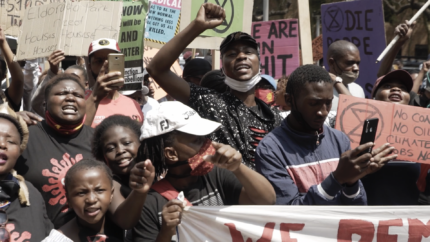
Far from “foreign forces”, it is the people of South Africa who are fed up with Mantashe and the department he leads. Just a few months ago, thousands of people in every province of South Africa mobilised under the banner of #UprootTheDMRE to protest against Mantashe and the DMRE’s polluting, unjust and harmful energy and mining agenda.
The protest was led by mining-affected communities, tired of Mantashe greenlighting polluting and harmful projects without their consent. It was led by young people, unwilling to have their future condemned to climate chaos by the DMRE’s plans for lots of polluting coal, oil, and gas.
It was led by communities sick of being plunged into darkness through load shedding. Communities that lack proper access to energy, because the DMRE refuses to unlock a renewable energy future that would be the fastest, most affordable and most job-creating way to bring new energy online.
It was led by workers and communities demanding a just transition to renewable energy that leaves no one behind. It was led by fishing groups and coastal communities resisting Mantashe’s scandal-ridden plans for polluting powerships, which could devastate local fishing grounds and cost South Africa hundreds of billions of rands.
Showing his disdain for the people he is supposed to answer to, Mantashe and his department refused to officially respond to the demands of those protesting. Reflecting his authoritarian streak, Mantashe did, however, get his lawyers to threaten to sue me, the secretary of the Climate Justice Coalition, which helped organise the #UprootTheDMRE mobilisation.
It seems that Minister Mantashe might actually be the one deserving of a lawsuit against him, given that he is spreading falsehoods to dishonestly discredit his critics.
Selling out to polluting corporations
Unlike Mantashe’s unsubstantiated accusations though, there is quite robust evidence that Mantashe himself is very much working to the benefit of foreign forces — forces much more greedy and malicious than a children’s foundation, like rapacious Western oil and gas multinational corporations.
We can start with the recently reported revelations around the ANC receiving funding from Batho Batho Investments trust to pay the salaries of its employees — employees whom a financially mismanaged ANC had failed to pay. That same trust holds about 47% of the investment group Thebe, which in turn has a 28% stake in Shell’s downstream business in South Africa.
Is it a mere coincidence that at the same time that the ANC was getting money from Batho Batho, Mantashe was fiercely advocating for (Royal Dutch) Shell’s plans to conduct seismic testing off the Wild Coast? Might that help explain why he was accusing local communities and activists who resisted Shell of enacting “colonialism and apartheid of a special type”?
Despite professing to be a resister of Western imperialism, that’s hardly the first time Mantashe has acted to the benefit of foreign multinationals wanting to extract the natural wealth of South Africa, often over the resistance of South Africans. To borrow the words of South African researcher Dr Neil Overy:
“[Mantashe] should reflect on his pseudo pan-African, anti-imperialist rhetoric by looking a little closer at who is exploring and extracting oil and gas on the continent. Both historically and now, he will find it is almost entirely dominated by companies from the Global North. He may want to glance a little more carefully at the current map that carves up the coast of South Africa mostly between European and American oil and gas companies like Total, Shell, Eni and others. One cannot but reflect on the maps that emerged from the Berlin conference in 1884, where Africa was similarly carved up for European exploitation.”
As Dr Overy’s research highlights, it is Mantashe who is the one serving foreign corporations over the resistance of local communities. It is Mantashe, more than anyone, who can be accused of perpetuating “colonialism and apartheid of a special type”.
Local communities seem to agree. Like the Amadiba Crisis Committee, which has long been resisting Mantashe’s extractivist projects in their home of emaMpondweni. In response to their victory over Mantashe in the Shell case, they wrote that:
“Mantashe’s department is the doormat that the multinational corporations use when they clean off their boots before entering the country to continue their colonial looting. This is why Mantashe’s losses in court are celebrated as victories for the people and for democracy.”
The menace of the media
The media has also been quite outspoken in its criticism of Mantashe.
The Sunday Times recently named Mantashe “Mampara of the Week” for his fossil-fuel-loving antics. Daily Maverick named him polluter of the year. The Mail & Guardian gave him an E rating for his performance, and suggested that he should do the “country a favour — resign”. Similarly, News 24 gave Mantashe 2/10 in their ratings, saying he “needs to go”.
For Mantashe, this is all evidence of some grand conspiracy against him. Perhaps more simply, it’s evidence that the people of South Africa are fed up with him. Fed up that their country and future are being sold off to foreign corporations to the benefit of an elite few connected ANC members and cadres.
It’s worth reflecting on how the apartheid government loved to spin conspiracies accusing the media and people of South Africa of being agents of foreign forces. Authoritarians everywhere love to demonise the media and civil society to deflect from the legitimate criticism they face.
Rather than blaming foreign forces for attacking him and “destabilising” his Department of Mineral Resources and Energy, perhaps it’s time Mantashe reflects on how his department and party’s actions are destabilising our country, our economy, and the only planet we call home.
Perhaps he should realise that the reason people are protesting is that they know that a more socially and ecologically just energy and mining future is possible, and they know that Mantashe and his DMRE are the biggest obstacles to the future they are demanding.
This article was first published by The Daily Maverick.
]]> The Coalition says it views Minister of Mineral Resources and Energy Gwede Mantashe as the biggest obstacle to a just climate, energy, and mining future. Activists have in the past accused Mantashe of being pro-coal. By Brenton Geach]]>
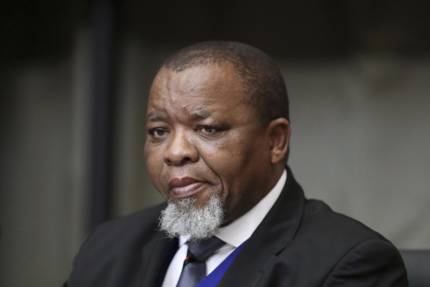
The Climate Justice Coalition on Friday called for the Minister of Mineral Resources and Energy Gwede Mantashe to step down from his position, to pave the way for a renewable future in South Africa.
The Coalition said it viewed Mantashe as the biggest obstacle to a just climate, energy, and mining future. Activists have in the past accused Mantashe of being pro-coal.
The group describes itself as a coalition of South African trade unions, grassroots, community-based and non-profit organisations. It said it had a diverse array of members working on a variety of social, labour, health, environmental, energy, education, gender, human rights, and climate justice issues.
The Coalition hosted a People’s Tribunal to put the Department of Mineral Resources and Energy (DMRE) on trial “for their polluting and harmful policies and practices”. It also called for the just energy transition so that advanced environmental, energy, climate, and economic justice can happen.
Activists from across the country spoke about how the mining industry has impacted the communities in their respective provinces.
Eastern Cape’s Lungisa Ngapi from Extinction Rebellion said DMRE was posing a danger to the province’s marine ecosystem.
He said the Karpowership floating power plants project and the testing done by Shell before drilling for oil and gas all posed dangers to the marine environment.
“All of this has been done to maintain the dependence on fossil fuels. This is unnecessary, we have an abundance of the sun to produce energy. We want the DMRE to get out of our way as they refuse to help us,” Ngapi said.
Recently, Shell lost its bid to appeal against an interim interdict for seismic survey operations after small fishing communities protested along Eastern Cape, KwaZulu-Natal, and Western Cape shores, voicing their stance against seismic activity. Mantashe criticised the treatment that Shell received in South Africa.
Themba Ncezi from Tswaranang Africa, a representative of the Free State, said the province was the country’s food basket as it had many mines.
“Those mines now are shelters of crime. When we approach the DMRE about this, it is always hiding in a private building, we can’t easily access it,” he said.
Ncezi said the department was also licensing foreign companies which rehabilitate tailings.
“When the tailings are rehabilitated they go through reprocessing, this affects the water and air quality. People are getting sick because of it. There is no process to the communities that says we recognise you,” he said.
A Western Cape representative said: “We have the Koeberg power station that is not running at full capacity as it is not maintained correctly. Mantashe has a plan to extend nuclear energy, which is a problem. Mantashe and the DMRE need to hear the people and let our people tell us how to go forward,” she said.
Most speakers said the department doesn’t consult communities about the mining activities that it gives licences for.
A Limpopo representative said: “In the Lephalale area, most of the mining rights that the department grants to the mining companies were done without the participation of the communities, especially those that are going to be affected by those operations.”
Themba Khumalo from KwaZulu-Natal said the grazing land for cattle in the area is no more because of mining operations.
“We are grieving. We are saying to Mantashe, and the DMRE enough is enough. They are granting unlawful mining permits to these mining companies, who extract our resources and leave us with dumps.
“We don’t need new coal, forward with just transition. We demand the DMRE and Mantashe to find new ways of working,” Khumalo said.
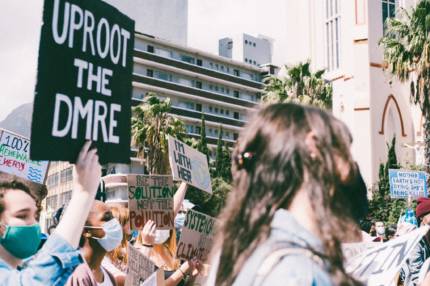
Meanwhile, in Cape Town on Friday, a protest was held as part of the Global Climate Strikes led by youth climate activists globally.
Some of the demands on the memorandum included a call to prioritise how people will be affected by the climate crisis over the profits that come with extraction and continued coal use.
This article was first published by Independent Online
]]>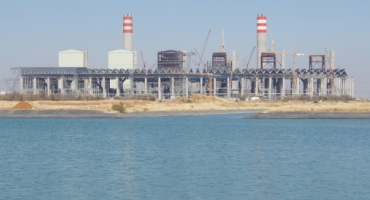 Protests will kick off tomorrow aimed at reforming South Africa’s Department of Mineral Resources and Energy (DMRE).]]>
Protests will kick off tomorrow aimed at reforming South Africa’s Department of Mineral Resources and Energy (DMRE).
]]>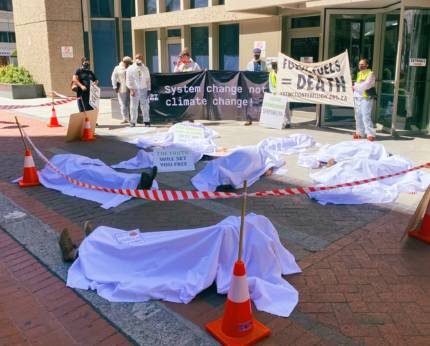 Cape Town - Ahead of the global climate strike organised by the Climate Justice Coalition (CJC) this week, a demonstration was held on Wednesday outside the Department of Mineral Resources and Energy’s (DMRE) Cape Town offices where employees and passers-by came face-to-face with what appeared to be a gruesome crime scene with dead bodies laying in front.]]>
Cape Town – Ahead of the global climate strike organised by the Climate Justice Coalition (CJC) this week, a demonstration was held on Wednesday outside the Department of Mineral Resources and Energy’s (DMRE) Cape Town offices where employees and passers-by came face-to-face with what appeared to be a gruesome crime scene with dead bodies laying in front.
]]> Extinction Rebellion Cape Town along with partner organisations from the Climate Justice Charter Coalition staged a Climate Crime Scene outside the local offices of the Department of Mineral Resources and Energy (DMRE) on Wednesday.]]>
Extinction Rebellion Cape Town along with partner organisations from the Climate Justice Charter Coalition staged a Climate Crime Scene outside the local offices of the Department of Mineral Resources and Energy (DMRE) on Wednesday.
]]>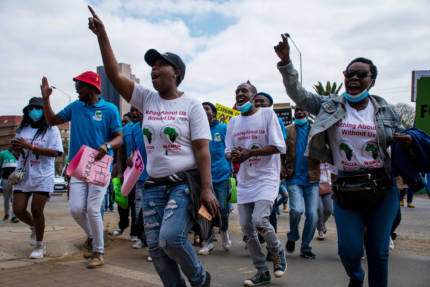 Members of mining-affected communities and organisations combating the climate crisis have chained themselves to the gates of the Department of Mineral Resources and Energy in Tshwane, demanding the implementation of policies on renewable energy and Minister Gwede Mantashe’s resignation.]]>
On Wednesday, climate crisis organisations, mining communities and labour unions in solidarity with the Climate Justice Coalition kicked off a nationwide campaign against the Department of Mineral Resources and Energy, demanding that Minister Gwede Mantashe step down, that affected communities be included in decision-making, a just transition to renewable energy and an end to new coal, gas and oil practices.
]]>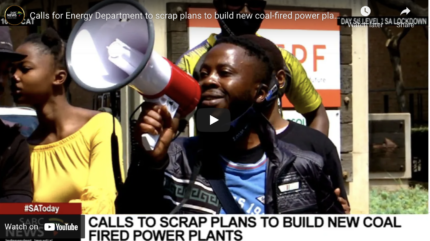 The Department of Minerals and Energy has been given until the 8th of October to respond to demands by the Climate Justice Coalition to scrap plans to build new coal-fired power plants. And to rather use clean, safe, affordable renewable energy. This will help fast-track Eskom's transition to renewable. They are also demanding answers to Nersa's approval of three-generation licences for floating power ship provider Karpowership and for government officials of the department to be investigated for irregular deals.]]>
The Department of Minerals and Energy has been given until the 8th of October to respond to demands by the Climate Justice Coalition to scrap plans to build new coal-fired power plants. And to rather use clean, safe, affordable renewable energy. This will help fast-track Eskom’s transition to renewable. They are also demanding answers to Nersa’s approval of three-generation licences for floating power ship provider Karpowership and for government officials of the department to be investigated for irregular deals.
]]>